









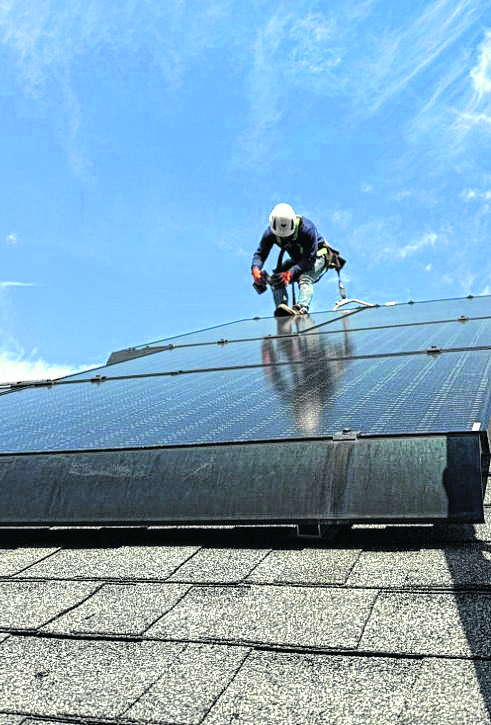
Taxpayers and homeowners across Nassau, Suffolk, and the Rockaways are absorbing the fallout from Washington’s January decision to kill the 30% Section 25D residential clean energy tax credit, and the numbers show it’s already hitting Long Island’s solar market hard.
That credit covered roughly a third of installation costs. Gone now. What’s left is a New York State incentive capped at $5,000, which helped households during the years the federal program ran but doesn’t come close to filling the gap Washington left behind. The math on going solar got considerably worse overnight, and the industry is adjusting in ways that aren’t pretty.
EmPower Solar is winding down. The company pointed directly at the federal credit’s disappearance as the reason. It won’t be the only casualty. Inflation had already squeezed margins before January’s cutoff arrived, and rising borrowing costs made residential installations a harder pitch even when the 30% credit was still on the table. Now it’s gone, and some companies are simply selling less.
Sometimes the economics still pencil out, though.
“Other companies out there are selling lower volumes, but still getting homeowners to install solar,” Michael Voltz, director of energy efficiency and renewables for PSEG Long Island, told Long Island Press. “It’s still a good long-term investment. With the price of oil and gas going up, there are some benefits there.”
Voltz didn’t sugarcoat the damage, but he put it in context. Just under 100,000 electric accounts across Nassau, Suffolk, and the Rockaways carry solar installations today. That’s a foundation built over years of steady residential uptake, and it doesn’t evaporate because Washington reversed course on one incentive program.
LIPA’s capacity figures back that up. Long Island’s service territory held 1,146 megawatts of solar at the end of 2024. By the close of 2025, that had grown to 1,239 megawatts. As of February 2026, the total stood at 1,252 megawatts. LIPA’s 2030 goal of 1,310 megawatts now sits within reach, with Long Island at 96% of that target. For a region that spent much of the previous decade trailing solar-friendly states, that’s a real achievement.
But the forward projections are where the story turns. Before January’s rollback, Long Island was adding 66 megawatts of residential solar annually and another 30 megawatts from non-residential sources. LIPA now expects annual residential additions to fall into the 47 to 55 megawatt range, with non-residential growth dropping to somewhere between 16 and 19 megawatts per year. That’s not a minor rounding adjustment. Compounded over several years running up to 2030, the shortfall is significant, and it’s a direct consequence of what happened in Washington.
NYSERDA’s state programs remain available to Long Island homeowners, and the $5,000 state incentive hasn’t gone anywhere. But state-level support has never been structured to carry the entire load the federal program was handling, and it’s not going to start now.
“The future trajectory of solar is unclear with the sunset of the federal tax incentive,” a LIPA spokesperson said.
LIPA CEO Carrie Meek Gallagher took a different tone. “LIPA is committed to driving the growth of solar energy on Long Island,” Gallagher said. “We are making steady progress with solar projects already in development while establishing strategic partnerships that lay the groundwork for future opportunities.”
That’s the official line. The capacity numbers do support some optimism, since reaching 96% of a 2030 target in early 2026 is a position most utilities in this country don’t find themselves in. But the rate of growth is slowing, the companies doing the installing are pulling back, and the state incentive of $5,000 isn’t going to move the needle the way a federal 30% credit did for a typical Long Island homeowner staring at a $30,000 installation quote.
Voltz’s point about oil and gas prices is worth sitting with. Long Island’s energy costs are among the highest in the country, and that structural reality hasn’t changed. For homeowners who can absorb the upfront cost without the federal subsidy, the long-term calculus may still favor solar. But that pool of homeowners is smaller now than it was in 2024.