








Long Island taxpayers weren’t just burdened by British occupation after August 1776. They were stripped clean.
After the Battle of Long Island, George Washington’s forces folded and retreated, leaving Nassau and Suffolk Counties under British control for the rest of the Revolutionary War. That occupation wasn’t passive. British fortifications lined the entire South Shore, running from Fort Greene in Brooklyn east to Sag Harbor. Supply ships worked the coastline after dark, and as historian Warren McDowell documented, “The British would ship timber, or whatever they could pilfer, to send to their New York City headquarters,” McDowell said. Seven years of that kind of extraction hollows out a community. The men who pushed back on the water don’t get nearly enough credit.
The Continental Congress faced a hard problem. It had a militia it couldn’t fully rely on and almost no navy. Its answer was the Letter of Marque, a government-issued license authorizing private ship captains to attack enemy vessels. Not pirates. Licensed ones. That’s an important distinction, and one the American Battlefield Trust’s Revolutionary War resources lay out clearly when explaining how Congress funded naval disruption without funding a navy.
The numbers are striking. Congress issued 1,700 Letters of Marque during the Revolution. Those operations resulted in the capture of 600 British ships. In New York and New England, the letters came from one of three officials: John Hancock, President of the Continental Congress; Jonathan Trumbull, Governor of Connecticut; or George Clinton, Governor of New York. Suffolk County produced privateers who hunted British supply lines, and one hamlet sat at the center of that effort.
Blue Point, a small community in the Town of Islip along the Great South Bay, operated as an active privateering hub. It’s a chapter that history’s largely forgotten. The hamlet’s geography made it dangerous to British shipping. It sits directly across the bay from what is now Point O’ Woods on Fire Island, which in the 18th century was the location of the main Fire Island inlet before it filled in. British supply ships used signal fires called beacons to navigate that inlet after dark, then pushed west along the shipping lane toward the city.
McDowell, author of “Blue Point Through the War Years,” reconstructed this operation through research documented in Great South Bay News. His account explains how the inlet’s position made British ships vulnerable during those nightly runs. The National Archives holds records of Letters of Marque that can be cross-referenced against the specific vessels and captains operating in Long Island Sound during that period.
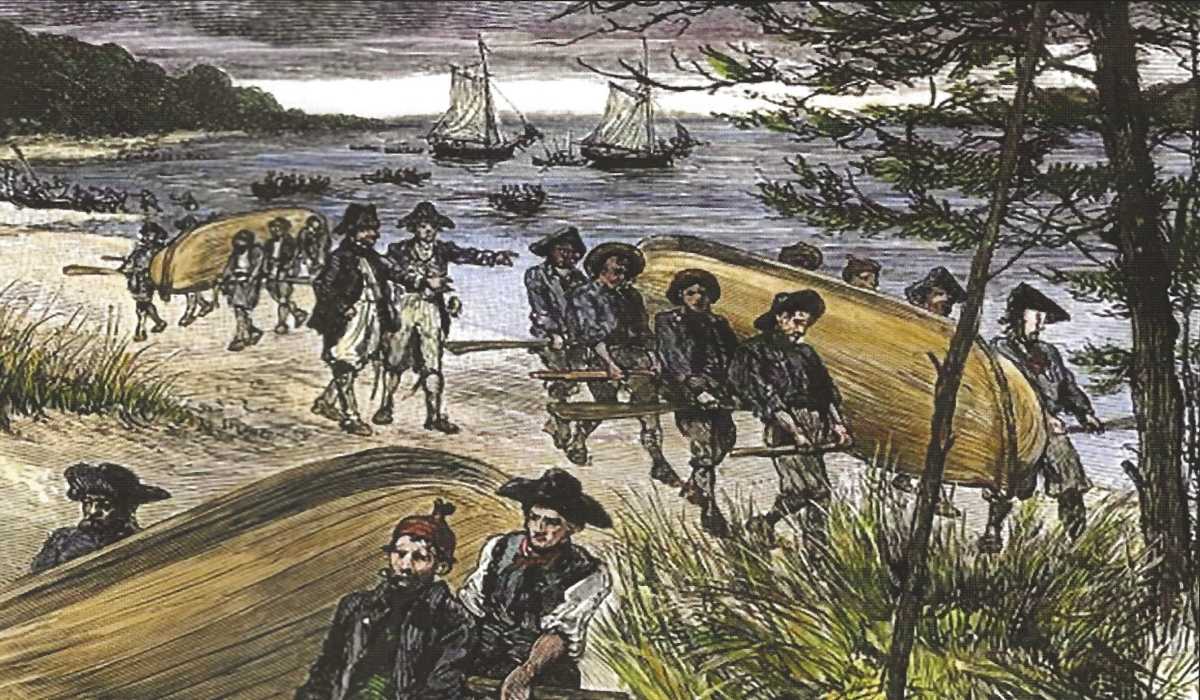
Privateers in this region didn’t operate large warships. They used what worked. McDowell’s research identifies two primary vessel types: whaleboats with cannons mounted at each end, and periaugers, which were shallow-draft flat-bottom craft equipped with swivel guns. Small, fast, hard to track at night. A successful raid split the take with the crew receiving 50 percent of everything captured, including the ships themselves. Those vessels were sailed to New London and auctioned off. Crews could turn a single good raid into real income.
The privateering campaign tied directly to broader wartime economics. Suffolk County’s role wasn’t symbolic. It was logistical. Blue Point’s position across from the Fire Island inlet put it exactly where British supply chains were most exposed. The community had whalers who knew the bay in total darkness. That wasn’t a coincidence. It was a competitive advantage the Continental Congress was smart enough to pay for.
A few dates anchor this history. March 17, 1744 predates the Revolution but marks an early context for colonial maritime commerce in the region. The privateer campaigns intensified after 1776, and by May 20, 1778, British pressure on Long Island supply disruptions was documented in command dispatches. By December 5, 1778, British naval records reflect the cumulative cost of privateer attacks along the South Shore corridor. That’s 45 documented months of continuous raiding pressure across a 17-mile stretch of coastline, with 20 or more active privateers operating out of South Shore communities at peak periods.
The Long Island Press account of this period draws on McDowell’s research and contemporary British dispatches to reconstruct the scale of operations that most Long Islanders have never heard of.
Suffolk County produced fighters. They just didn’t fight on land.